




Health Corner
 Health Corner
Osteoporosis doesn’t just increase the risk of fractures—could its impact actually last a lifetime?
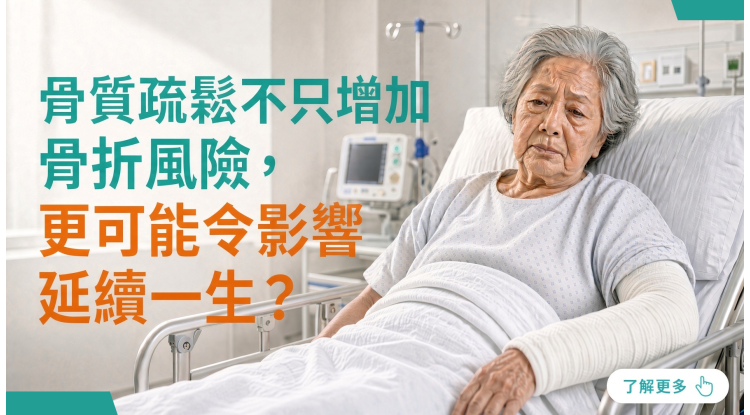
According to data*, after experiencing a fracture, the risk of a secondary fracture can increase by up to 10 times, with the risk being highest in the first two years following the initial fracture. In severe cases such as hip fractures, the one-year mortality rate can reach as high as 17.3%. Even if less severe, it may still lead to functional problems such as joint stiffness, limited mobility, or muscle atrophy, impacting daily life. Preventing fractures starts with addressing osteoporosis.
Are you or elderly family members high-risk individuals for fractures?
- Aged 65 or above without regular bone mineral density (BMD) check-ups
- Low bone mineral density (e.g., T-score ≤ −2.5)
- History of multiple falls Many people mistakenly assume that osteoporosis is simply a natural part of aging and impossible to improve once it occurs.
In fact, osteoporosis can be improved through appropriate medical treatment and ongoing management—the key is early detection.
Can osteoporosis be reversed? In medical terms, osteoporosis can be "reversed." Of course, this reversal does not mean returning to the bone state of one's youth, but rather progressing from a "high-risk zone" to a "safe zone." Through continuous and correct pharmacological treatment, nutritional supplementation, and exercise, a patient's bone density and muscle mass can improve significantly, and bone structure can be restored, thereby drastically reducing the risk of future fractures.
Why are you more prone to a second fracture after having one? The medical community refers to this phenomenon as the "fracture cascade effect" or "domino effect," driven mainly by the following reasons:
-
The root cause, "osteoporosis," remains unaddressed: Many initial fractures stem from minor falls, light bumps, or even everyday actions like sneezing (fragility fractures). If only the broken bone is treated without tackling the underlying osteoporosis, the chance of refracture remains high.
-
Fractures trigger cascading collapses: Taking vertebral fractures as an example, when one vertebra collapses, the weight-bearing balance of the spine is disrupted. The body's center of gravity shifts forward, placing greater pressure on adjacent vertebrae and increasing the risk of cascading collapse.
-
Post-fracture condition easily triggers a vicious cycle: Due to pain or fear of re-injury, physical activity is reduced after a fracture. This can lead to muscle loss, joint stiffness, and impaired balance, which significantly increases the likelihood of falling again—creating a vicious cycle.
This is why regular check-ups are strongly recommended, as early detection and early prevention are vital. The pain of a fracture can potentially persist for a lifetime, and prevention is always better than cure. If you or someone close to you belongs to a high-risk group, it is advisable to learn more about preventive measures early and undergo regular DEXA bone density
scans:https://mall.humanhealth.com.hk/products/dexa
*Reference source: The Osteoporosis Society of Hong Kong


